The Damascus Document
An essay from a dozen or more years ago.

It is the contention of this essay that the Damascus Document draws its main inspiration from Ancient Greek myth. There also seems to be the possibility that there has been some transliteration of Ancient Greek words directly into the Damascus Document using the Aramaic or Hebrew alphabets1 and I would suggest that the most obvious example of this may be the word ‘Hagy’, as in the ‘Book of Hagy’. This would in turn suggest a fairly strongly Greek or Hellene identity for the members of the Qumran community. A more extensive study of the rules/laws laid down in the Damascus Document may bring up more parallels with the Ancient Greek world and an analysis of the archeological record including the type and alignment of the graves at the Qumran cemetery might also be of some help but that remains out of the range of the current 2000 word version of this essay.
In 1897 Dr Solomon Schechter found in a Cairo Karaite Synagogue over 140,000 fragments and documents from the 10th and 11th Centuries including what is now referred to in shorthand as the CD or the Cairo Damascus document. An older, but more fragmented, version of this document was later found at Qumran (in the late 1940s) by Bedouin. The CD remains of much interest because of the slight differences in the text and the different ordering of the text between the two discoveries. The Cairo text has also allowed a much better reconstruction of the Qumran text than possible with some of the other Qumran texts. This in turn allows for more detailed analysis of the actual text.
In his “The Influence of Hellenistic Secular Poetry Upon the Dead Sea Scrolls”2 Glen G. Aduana compares the Dead Sea Scrolls, especially the Damascus Document, to the great literary canon of the Ancient Greeks. For example he compares the following that is in the Damascus document (but using the New Revised Standard Version translation of Psalm 151);
The mountains do not witness to him,
nor do the hills proclaim;
The trees have cherished my words
and the flock my works.
to the Greek mythic figure of Orpheus “whose legendary singing was
so powerful that the entire countryside was moved when he played”4. Orpheus is of course the mythic figure who kept on singing even as his disembodied head floated down the River Hebrus5. If we put aside for the moment that Orpheus and his wife are very much like the Biblical Lot and his wife in the earlier part of that Greek myth we may instead shift our attention to Apollo who managed to quiet Orpheus when he finally made it to Lesbos (or at least when his head made it there).
Apollo, or at least his Biblical equivalent, seems to figure from the very beginning in the Damascus document that starts off with a reference to a fallen people and the devastation that came upon them because of their failure to abide by God’s laws. It states that “and abominated the generations on account of blood and hid his face”6 and “All flesh which there was in the dry earth decayed and became as if it had never been, for having realized their desires and failing to keep their creator’s precepts, until his wrath flared up against them”7. The parallel with Greek Myth here is with Oedipus who, after he had realized that he had been tricked into marrying his mother by the god Apollo, had proceeded to stab his own eyes out and thereby ‘hidden his face’. He of course also assumed that his misdeeds had bought deadly pestilence to his city8 much like the text in the Damascus Document clearly indicates has happened.
Rather interestingly Apollo in the Ancient Greek canon was known as the god of Light, his symbol was that of the serpent or the snake and he was very closely associated with the number seven9. There are therefore strong similarities of Apollo to Belial of the Damascus Document, and the Bible, who is reputedly some sort of Lord of Darkness10 although this is not clear in the Damascus Document itself where it could be construed that he is associated instead with light. Belial too is represented by the serpent or the snake and is also associated with the number seven11.
The Damascus Document also sets out the traps set for those who disobey God, or maybe Belial, and states that “They are Belial’s three nets about which Levi, son of Jacob spoke” and “The first is fornication; the second, wealth; the third, defilement of the temple”12. There are close parallels here to the Book of Jubilees where Noah warns his descendants “from fornication, uncleanliness and from all injustice”. But there are much stronger parallels to the Odyssey of Homer where the messenger, Argeiphontes, answered Apollo at one stage in the epic: “Would that this might befall, lord Apollo, thou archergod—that thrice as many bonds inextricable might clasp me about13” which is followed by the three Gods, one of Fertility (Poseidon)14, one of Commerce (Hermes) and one of the Delphic Oracle (Apollo) discussing those bonds (or nets as they are sometimes translated as) in a very similar, almost identical, manner as is set out in the Damascus Document.
Although the Ark is only briefly mentioned15, and in this context it may not be the story we know as Noah’s Ark (albeit it is taken as so by Martinez), it is worth noting here that the oldest version of the flood story is Atrahasis which is expanded on somewhat in the Epic of Gilgamesh. Both of these originate in Mesopotamia/Sumeria. But the Flood story also makes it into the Ancient Greek canon where the Noah like character is known as Deucalion. This Ancient Greek version is very similar to the Biblical version and unlike the earlier Sumerian Atrahasis and the Mesopotamian Gilgamesh (where the Noah like figure is called Utnapishtim) versions it includes a very Genesis like list of Deucalion/Noah’s descendents and the ‘nations’ that they founded. Once again we have strong Ancient Greek parallels to the Biblical narrative.
At one point16 in the Damascus Scroll we have the following rather enigmatic text “When the two houses of Israel separated, Ephraim detached itself from Judah, and all the renegades were delivered up to the sword; but those who remained steadfast escaped to the land of the north”. A straight reading of this would have Ephraim as an ally of Judah but not necessarily a part of the two houses of Israel, the second member of the two houses unmentioned. Here once again there is an interesting parallel with Ancient Greece, and that is Samos as the ally of Athens during the Peloponnesian War and possibly the exile of the Democrats after Lycurgus had conquered Samos. Athens and Sparta the equivalent of the two Houses.
Further the statement that “And Israel, they shall be ten in number as a minimum to (form) thousands, hundreds, fifties and tens”17 sounds rather peculiar to someone who has been bought up in a decimal system where the numbers would move from hundreds to tens without an intermediate step at fifties. It is also mentioned in the same way in Exodus 18:21 and 18:25 and Deuteronomy 1:15 of the Bible. An analysis of the systems in use by Ancient civilisations of the Near East show that the Babylonians used a base 60 system, the Egyptians a standard decimal system and the Phoenicians a numeral system consisting of separate symbols for 1, 10, 20, and 100 in a more or less standard decimal system. So we don’t find any help there. The Ancient Greeks on the other hand differentiated five, fifty and five hundred, in fact five was an integral part of their numeric system. The only other power to have used fives as part of their numerical system would seem to be the Romans but it would be assumed that they’d copied the Ancient Greeks. The peculiar counting in the Damascus Document is therefore most likely Ancient Greek in origin albeit there is the slight possibility that it is Roman. It would seem odd that a people of Palestine who were not only not Greek but also fairly strongly opposed to the Greeks would have used it (the same could be applied to the Romans if needed).
The Book of Hagy mentioned quite frequently in the Damascus Document seems to have caused some confusion in DSS circles. There are several different theories about what it might refer to or what the letters or the word might mean often attempting to place the root of the word in Aramaic or Hebrew. But it seems that Hagy is simply Ancient Greek for Holy18. As a reference therefore to the ‘Book of Holy’ the meaning would seem obvious. The Greek word seems to have been transliterated using the Aramaic or Hebrew alphabet and this would possibly indicate a preference for the original Greek word.
In a similar manner is the reference to the House of Peleg. Some have surmised that this refers to the Pelagasians. Jacob Bryant surmised that Peleg or Pleg was a dispersion when he tried to make sense of Homer’s reference to it in the Illiad19 but this may be an anachronism as Pleg in Ancient Greek meant, as best as can be ascertained, ‘entwined’. This would seem to make sense in the context that it’s been used in the Damascus document (as well as in the Iliad), simply indicating that the two Houses of Israel are entwined.
The extent of the parallels between the Damascus Document and Ancient Greek Myth are a little surprising but nevertheless it would seem difficult to deny that they do exist. It is hard therefore not to consider the possibility that the people of Qumran were Hellenes first and Jews second. The seeming use of Greek terms/words written in the Aramaic or Hebrew alphabets also indicates an Ancient Greek or Hellene identification and the possibility that the Stories/Histories spoken of are Ancient Greek and not Near East or Levant20 in origin provides a further basis for this view.
I havn’t analysed the original documents as I am currently mostly unfamiliar with those Ancient languages.
Glen G. Aduana, The Influence of Hellenistic Secular Poetry Upon the Dead Sea Scrolls, May 1995, retrieved 5th September from; http://ccat.sas.upenn.edu/gopher/other/courses/rels/225/Research%20Projects/aduana.95
As Aduana points out this has been translated quite differently in Martinez where all four lines are treated in the negative.
Aduana brings up the interesting case of the Synagogue at Dura-Europos, which was at first thought to have been a Greek Temple, to suggest that the combination of Greek Myth and the Hebrew Canon was not unheard of in Ancient times.
Now the River Maritsa (Mary) in Northern Greece, on the border of Ancient Thracia and Macedon.
Florentina Garcia Martinez, The Dead Sea Scrolls Translated: The Qumran Texts in English, trans by Wilfred G. E. Watson (Leiden, EJ Brill, 1996) p. 34.
Ibid.
“Forourcity,asyouyourselfcansee,isbadlyshaken—shecannotraiseherheadabovethe depths of so much surging death. Disease infects fruit blossoms in our land, disease infects our herds of grazing cattle, makes women in labour lose their children. And deadly pestilence, that fiery god, swoops down to blast the city, emptying the House of Cadmus, and fills black Hades with groans and howls”, retrieved 7th September from; http://records.viu.ca/~johnstoi/sophocles/oedipustheking.htm
The day of Apollo’s birth was believed to have been the seventh of the month, whence he is called hebdomagenês. (Plut. Sympos. 8.) According to some traditions, he was a seven months’ child (heptamênaios). The number seven was sacred to the god; on the seventh of every month sacrifices were offered to him (hebdomagetês, Aeschyl. Sept. 802; comp. Callim. Hymn. in Del. 250, &c.), and his festivals usually fell on the seventh of a month”, retrieved on 5th September from
Although in the Damascus Document by my reading he seems to be, like Apollo, associated with light.
“Belial is the archfiend from whom emanate the seven spirits of seduction that enter man at his birth (Reuben ii.; Levi iii.; Zebulun ix.; Dan. i.; Naphtali ii.; Benjamin vi., vii.)”, Jewish Encyclopedia, retrieved 6th September 2012 from;
http://www.jewishencyclopedia.com/articles/2805-belial
Florentina Garcia Martinez, The Dead Sea Scrolls Translated: The Qumran Texts in English, trans by Wilfred G. E. Watson (Leiden, EJ Brill, 1996) p. 35.
Homer, Odyssey, [338], retrieved on 6th September from; www.theoi.com/Text/HomerOdyssey8.html
Although more well known as a Lord of the sea he was nevertheless originally a god of fertility and maintained elements of that role throughout.
“And the ones who went into the ark”
Florentina Garcia Martinez, The Dead Sea Scrolls Translated: The Qumran Texts in English, trans by Wilfred G. E. Watson (Leiden, EJ Brill, 1996) p. 36.
Ibid p.37.
Ibid p.43.
“ηαγι” in Ancient Greek. It’s not that easy to track this down but I am confident that I can back up this meaning if required.
Jacob Bryant seems to be one of the few to translate this greek word in the Illiad in that manner though.
I realize that this is somewhat of anachronistic term in this context but it also seems uniquely useful.
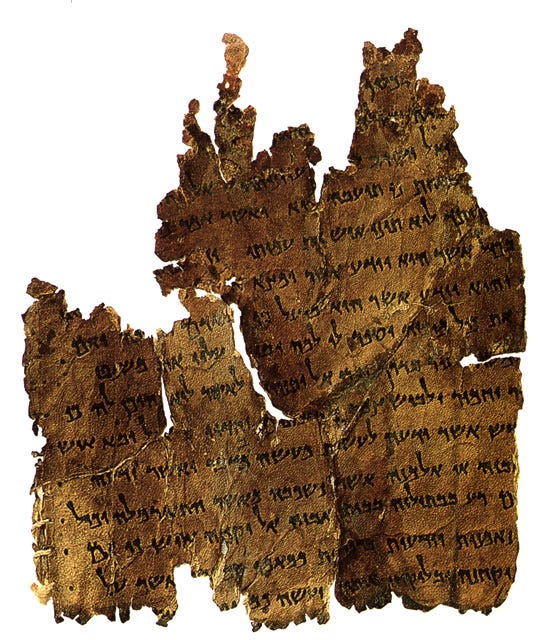
My contention is that the Hebrew religion (and people - across the River Hebrus maybe) were invented by the Ancient Greeks drawing on work done earlier by Plato. A work of the 1st Century BCE.
Excellent, so you were already onto the Hebrew from Greek twelve years ago.
It was a pic of the cairo synagogue.
Then anuda pic of a brick stack.